

When we talk about the quality of aluminium, often the first thing we think of is its chemical composition. The share of aluminium, alloying elements and impurities is certainly important, as it determines the basic properties of the material. However, aluminium quality does not depend only on what the material contains, but also on how it is produced, processed, controlled and adapted to its final application.
Chemical composition is only the foundation
Every aluminium alloy has a precisely defined chemical composition. Alloying elements such as magnesium, silicon, manganese, copper or zinc influence strength, formability, corrosion resistance, machinability and other important and required properties of aluminium.
However, two products with the same chemical composition can behave very differently in practice. The reason lies in the microstructure — or more specifically, in the way the material is processed, heat-treated, mechanically formed, surface-finished and controlled throughout the process. Therefore, chemical analysis alone is not enough to determine whether aluminium will truly meet the customer’s expectations.
The material’s microstructure has a major impact on its properties
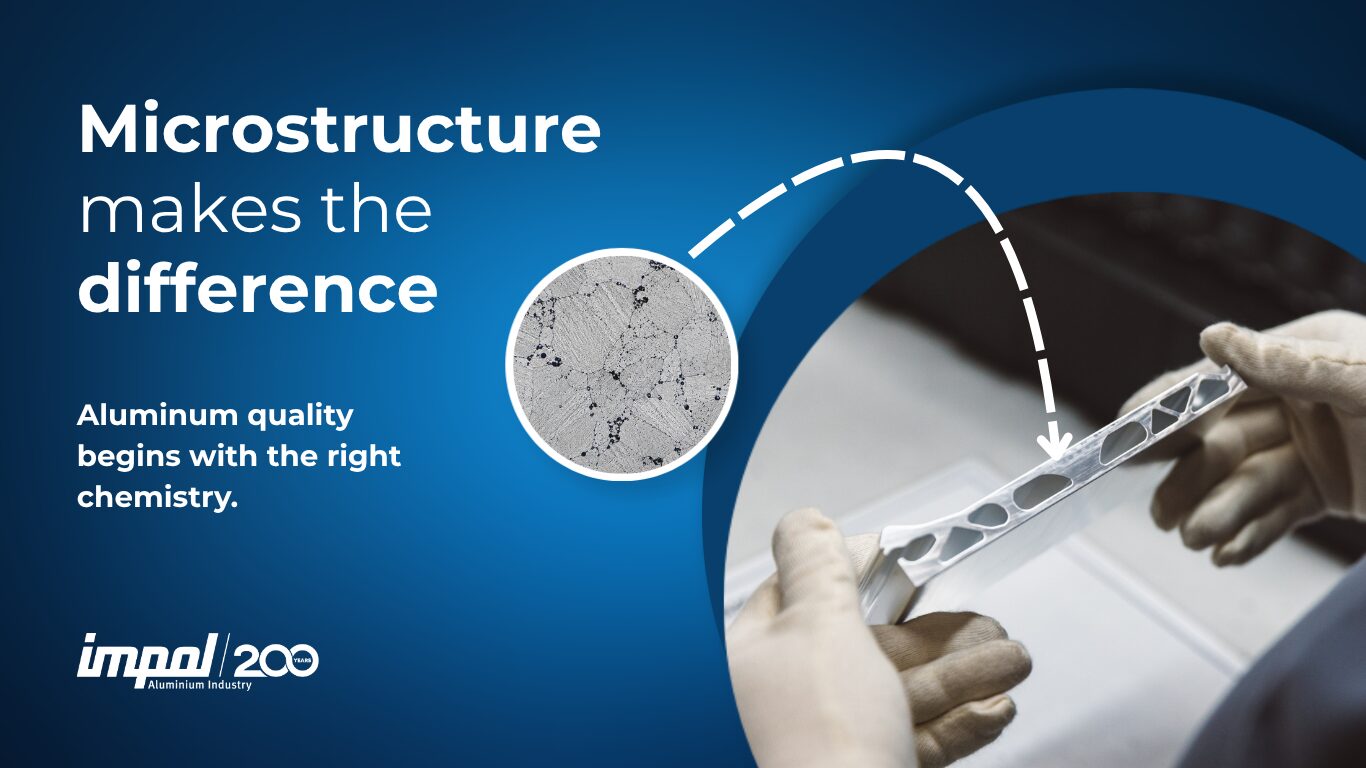
One of the most important factors in aluminium quality is its microstructure. It is formed during melting, casting, cooling, homogenisation and further processing. Grain size, phase distribution, the presence of defects and structural uniformity all have a significant impact on mechanical properties and on how the material behaves during further processing.
A well-controlled microstructure enables better formability, greater stability of mechanical properties, a lower risk of defects and more predictable product performance in use. This is especially important in demanding applications where aluminium products must meet high technical and safety requirements.
The production process also plays an important role
High-quality aluminium is the result of a stable and carefully controlled production process. Even when the chemical composition is correct, variations in temperature, casting speed, cooling process, deformation rate or heat treatment can influence the final properties of the product.
That is why precise monitoring of parameters and consistent implementation of prescribed procedures are essential in industrial production. Only in this way can it be ensured that a product has the same properties regardless of the batch, production line or time of manufacture.
At Impol, we understand quality as the result of comprehensive process control. This means that control is not limited only to the final product, but is integrated into all stages of production.
Mechanical properties determine the usability of the material
When selecting aluminium, customers are often primarily interested in how the material will perform in real conditions. Will it be strong enough? Will it form well? Will it withstand loads? Will it resist corrosion? Will it be suitable for further processing?
These questions cannot be answered by chemical composition alone. Mechanical properties such as tensile strength, yield strength, hardness and toughness are crucial. These properties result from a combination of composition, microstructure, type of processing and heat treatment.
Therefore, aluminium quality is always connected to its final purpose. The material must not only be properly produced, but also suitable for the application in which the customer will use it.
Surface quality is often just as important as internal properties
The surface also plays an important role in aluminium products. In foils, sheets, strips, profiles and other semi-finished products, the surface must be clean, uniform and free from defects that could affect appearance, further processing or product functionality.
Surface irregularities may occur due to improper material preparation, contamination, mechanical damage, tool defects or process-related errors. For this reason, monitoring surface quality is an important part of a comprehensive quality assurance system.
In many industries, such as the automotive industry, construction, electrical engineering, packaging and transport, surface quality is one of the key acceptance standards for a product.
Quality also means traceability and reliability
In modern industry, quality is no longer limited only to laboratory measurements. Traceability of materials, documentation, compliance with standards and supplier reliability are also essential.
Customers expect to be able to verify the origin of the material, production parameters, inspection and control results, and compliance with agreed requirements for every product. Such traceability provides greater safety, faster resolution of any deviations and long-term trust between the manufacturer and the customer.
Aluminium quality is therefore also a matter of responsibility. A reliable partner does not only provide material, but also technical support, development cooperation and stable supply.
True quality is created in cooperation with the customer
Because aluminium is used in many different industries, there is no universal definition of quality that applies to every case. A high-quality material for one application is not necessarily the best choice for another.
That is why it is important for the manufacturer to understand the customer’s needs, the final use of the product and the requirements of further processing. Only on this basis is it possible to select the appropriate alloy, material temper, dimensions, mechanical properties, surface treatment and other important parameters.
Chemical composition is an important foundation of aluminium quality, but it does not guarantee the final usability of the material on its own. True quality is achieved only when the right composition, suitable microstructure, stable production process, good mechanical properties, high surface quality, traceability and understanding of customer needs are combined into a complete whole.
Aluminium is a material with exceptional potential, but this potential can only be fully achieved through precise control on all stages of its production and processing. That is why aluminium quality is much more than numbers in a chemical analysis — it is the result of knowledge, technology, experience and a responsible approach to every product.